
Fierce Self-Compassion
Why real self-care includes self-compassion and boundaries
What if self-compassion isn’t just about being gentle with yourself, but also about being fierce?
Today we’re continuing a winter mini-series on embodied self-care. I know you’ve heard the term self-care, but we’re going beyond pedicures and date nights to see how we can practice a form of self-care that is not just momentary, but restorative.
And how giving ourselves compassion involves both tenderness and strength.
We love a both/and here at Walking the Middle Path! Read on for how to embody this both/and in self-compassion.
Make sure you read the start to this series on Embodied Self-Care.

Real Self-Care vs. Faux Self-Care
In the book Real Self-Care, Dr. Pooja Lakshmi defines faux self-care as “a method—in the moment, going for a run might improve your mood, but it does nothing to change the circumstances in your life that led you to feel drained, energy-less, or down.” She contrasts this with real self-care, which “is about going deeper and identifying the core principles to guide decision-making.”
“Real self-care is not only a more authentic and sustainable solution—it’s also self-determined. It involves the internal process of setting boundaries, learning to treat yourself with compassion, making choices that bring you closer to yourself, and living a life aligned with your values.”
—Dr. Pooka Lakshmi, Real Self-Care
So, to Dr. Lakshmi, real self-care is not about bubble baths, but boundaries, self-compassion, and values-driven choices. When we live a life aligned with our values, we live integrated. “You’ll know you’re practicing real self-care when it feels like your outsides are matching your insides.”

Fierce Self-Compassion
Previously, I did a series on boundaries and I also wrote in my book about living aligned with our values1. So let’s explore self-compassion more in-depth.
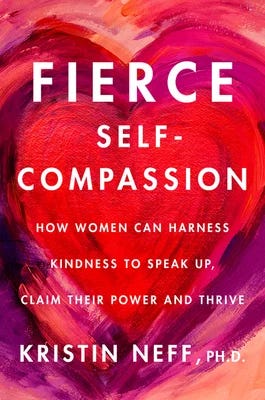
Dr. Kristin Neff, the author of Fierce Self-Compassion, argues that self-compassion has two faces: tender and fierce. Tender self-compassion is nurturing, soothing, and accepting. It’s when we give ourselves kindness and tell ourselves “I’m doing the best I can.”
Fierce self-compassion is protective, empowering, and motivating. It’s “the courage to confront injustice, set boundaries, and pursue change.” Neff sees anger as a powerful messenger that our boundaries have been crossed or that we (or someone we love) has been treated unfairly. We can use this anger as an ally to motivate us to set limits and make changes. Fierce self-compassion also fuels social justice as we confront systemic harm and advocate for social change.
True empowerment comes from the dialectic, or balance, of both tenderness and fierceness. Too much tenderness leads to passivity and avoidance. Too much fierceness leads to burn-out, disillusionment, and hopelessness. But together, walking the middle path, we find compassionate and embodied strength.

Middle Path Practice
A Middle Path Practice is an exercise that helps foster dialectical, both/and thinking. It helps us ask the question, what else are we missing here? What is the middle path?
Let’s integrate tenderness and strength to find the middle path.
First, offer yourself tender compassion.
Here are Neff’s steps to tender self-compassion2. (You can also find these steps adapted to overcoming the shame of purity culture in Chapter 12 of my book.)
Be mindful. Notice and name what you’re feeling. Externalize your emotion as something outside of yourself. “I’m noticing a feeling of shame come over me.”
Acknowledge your common humanity. Remind yourself that hard emotions and suffering are universal. “Everyone feels like a failure sometimes. I am not alone.”
Offer self-kindness. Offer yourself understanding and warmth instead of criticism. Place your hand over your heart, saying “May I be at peace.”
Now, let’s integrate this tender self-compassion with fierce self-compassion.
Identify your needs. Ask yourself, “What do I need to feel safe, respected, or supported?”
Set boundaries. Say no when needed to protect and preserve your time, energy, and well-being. “I can’t take that on right now. I appreciate you asking, but my plate is full.”
Listen to your anger. Use it constructively to motivate you to speak up or advocate for change. “This is not right. I’m going to say something.”
Motivate with kindness. Replace harsh self-talk (“I’m should be over this”) with compassionate affirmation, reminding yourself of your values (“I can continue to learn and grow.”)
Walking the middle path of self-compassion means embodying both tenderness and strength. This dialectic allows us to thrive as individuals and contribute to social restoration.
Here are some questions for reflection and journaling:
What is your understanding of real self-care? How is this different from what we traditionally think of as self-care?
Real self-care involves tenderness and fierceness. Which one is easier for you? How can you grow in the other one and integrate the two?
How was the Middle Path Practice for you? Please share in the comments how it went!
Walking the Middle Path is where we search for both/and in a faith and culture of black and white. Today’s post is free for anyone to access. To receive exclusive posts and support my work, please consider becoming a free or paid subscriber and share this post.
Warmly, Dr. Camden
Order my book from Amazon | Baker Book House
Work with me in Coaching | Therapy Intensives | Speaking
Check out my Website | Follow me on Instagram | Threads | Facebook
Specifically, how shame is resolved from figuring out our values to inform our sexual ethic and then living aligned with it. Read my book for more!
See Kristin Neff and Christopher Germer, The Mindful Self-Compassion Workbook: A Proven Way to Accept Yourself, Build Inner Strength, and Thrive (New York: Guilford Press, 2018).
Thank you for this incredible explanation of self-compassion. Many people think self-compassion is some excuse to let yourself off the hook, but self-compassion is fierce and tender. I just shared a self-compassion for writers resource that walks through how to respond to resistance and perfectionism in the writing process with self-compassion. Hope it’s okay to share here! https://alyprades.substack.com/p/self-compassion-for-writers